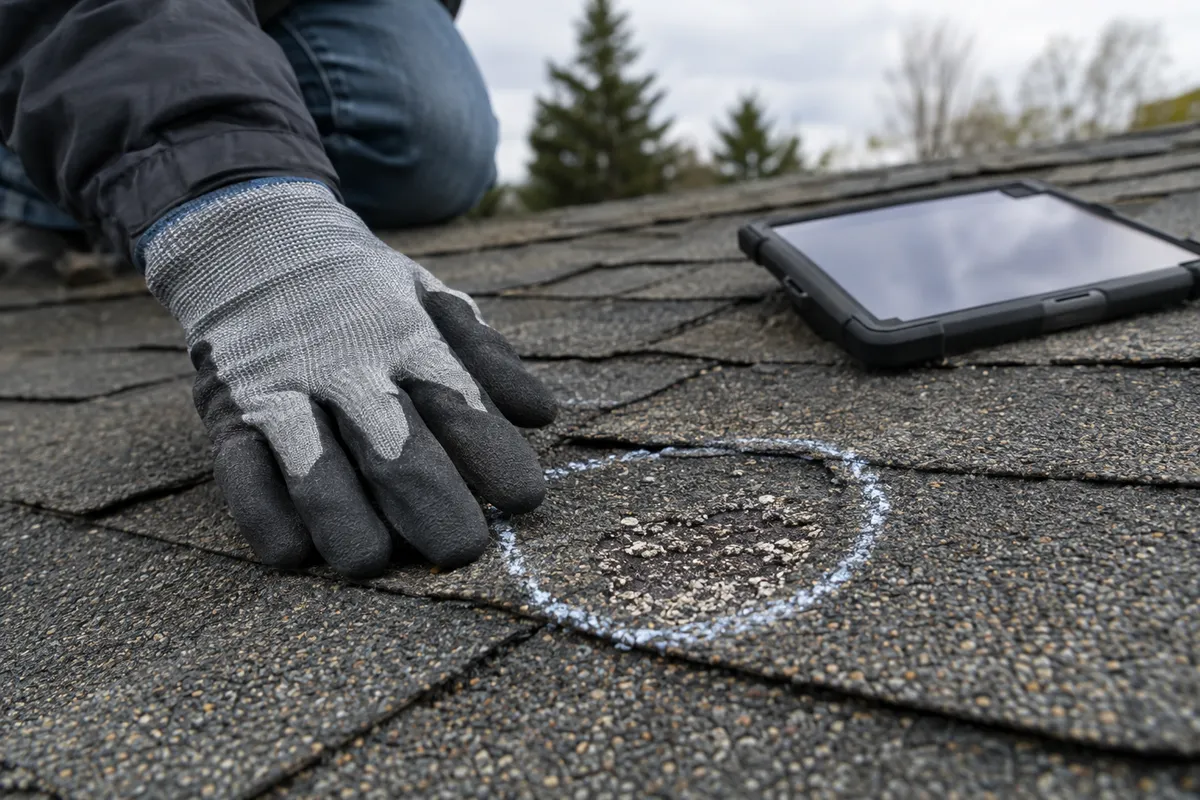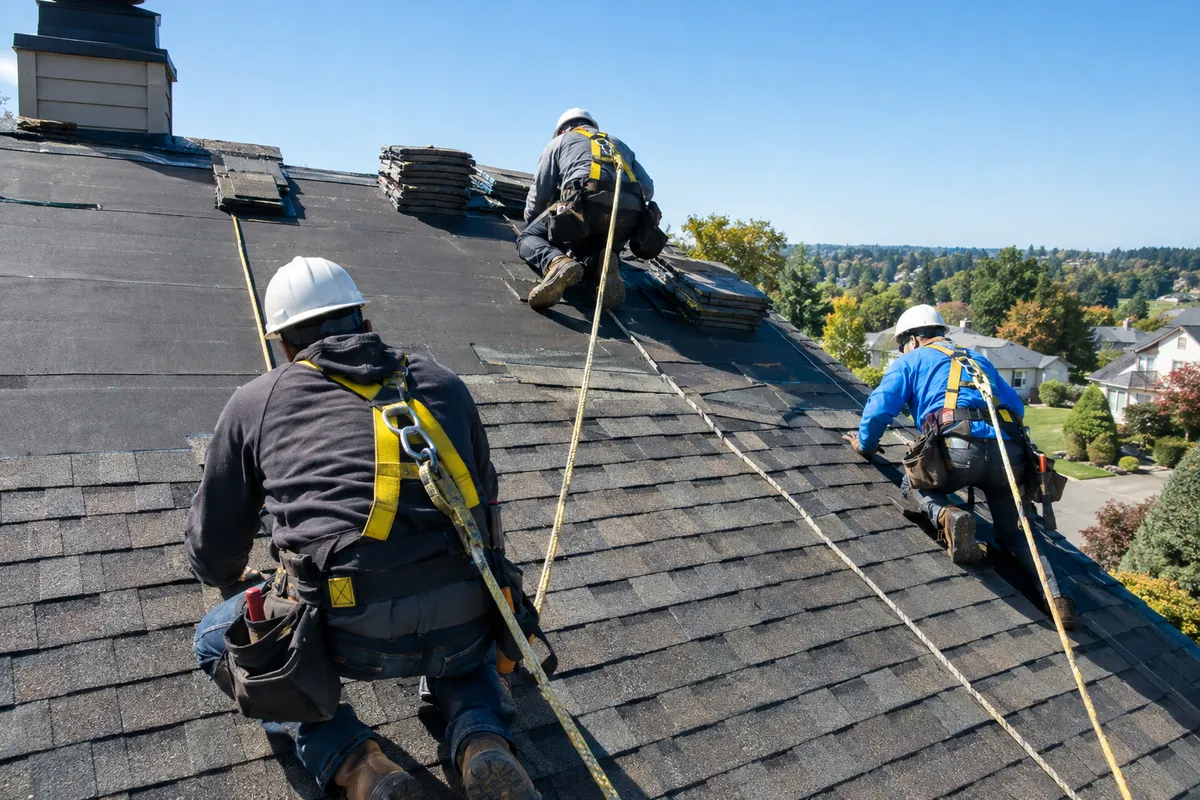

If water is coming through your ceiling, your first hour has three jobs: protect people and belongings, limit how much water gets in, and document everything. Then you need a licensed roofer on the roof, not you. In Northern Virginia, we start every job with a free, photo-documented inspection and a written proposal, so the same photos that guide the repair also support your insurance claim. You can reach us through our storm damage restoration team when a leak can’t wait.
This guide covers what to do inside the house, why you should stay off the roof, what to photograph, what insurance usually covers, what repairs cost, and how to choose between a repair and a replacement.
TL;DR
- Move people, furniture and electronics away from the leak, catch the drip in a container, and shut off power to any room where water is near fixtures or outlets.
- Photograph and video everything before you clean up, then call your insurer promptly.
- Don’t climb onto a wet or damaged roof. OSHA says never to install a tarp while it is windy or raining.
- Temporary measures only buy time. Permanent repairs should wait until your insurer’s adjuster has seen the damage.
- Call a roofer the same day if you can’t find where the water enters, if water is spreading, or if the ceiling is sagging.
Table of Contents
- Is a roof leak an emergency?
- The first hour, step by step
- Why you should stay off the roof
- What emergency roof repair looks like with a contractor
- Does homeowners insurance cover a leaking roof?
- What does an emergency roof leak repair cost?
- Repair or replace after a leak?
- What to check after the emergency is over
- Roof leak help in Fairfax and Northern Virginia
- Our perspective: documentation is the real emergency tool
- FAQ
- Sources
Is a roof leak an emergency?
Treat it as an emergency when water is actively entering the house, when it is near electrical fixtures, when the ceiling is bulging or sagging, or when a storm has removed shingles or opened a hole. A slow, small stain that appears only after heavy rain is urgent but not an emergency. It still needs an inspection soon, because water that sits in insulation, drywall and framing keeps causing damage after the rain stops.
The reason speed matters is cost. Roofing guides commonly point out that a quick temporary cover costs far less than drying, demolition and restoration after water has soaked into the structure. The longer a leak runs, the more of the house it reaches.
The first hour, step by step
The steps below are the same ones that professional and insurance sources recommend. The Colorado Roofing Association’s homeowner guide and State Farm’s leaking roof guidance agree on the basics.
1. Protect people and the electrical system
Keep everyone out of the room if the ceiling is sagging. Water-laden drywall can fall without warning. If water is dripping near a light fixture, ceiling fan or outlet, turn off the power to that area at the breaker panel, but only if you can reach the panel without standing in water. If you can’t, call an electrician or your utility before you touch anything.
2. Move belongings and catch the water
Move furniture, rugs and electronics out of the drip zone. Put a bucket or large container under the drip. If the water is running down the ceiling in several places, lay plastic sheeting or towels under it and move the container as needed. A common trick for a bulging ceiling stain is to relieve the pressure by poking a small hole at the lowest point of the bulge into a bucket. Do this only if the area is small and nobody is standing under it, because wet drywall can give way.
For drying and repairing the ceiling itself once the roof is fixed, this ceiling water damage repair guide walks through what the damaged area needs.
3. Look for the entry point from the attic
If it is safe, check the attic. The University of Wisconsin Extension’s leaky roof guide notes that leaks are rarely directly above the stain on the ceiling. Water travels along rafters, pipes and insulation before it drips. Look for a trail of dampness, dark staining on the underside of the roof deck, or wet insulation, and note where it starts.

Common sources include a failed pipe boot (the rubber collar around a plumbing vent), loose or missing shingles, and gutter problems. State Farm also lists missing nails left behind after a satellite dish removal. Flashing, the metal strip that seals joints around chimneys, walls and skylights, is another frequent culprit. If the water seems to come from around a chimney, this overview of chimney repair signs and fixes helps you recognize what you are seeing.
If you can’t find the entry point, that is your cue to call a roofer. Guessing wastes time while water keeps coming in.
4. Take photos and video before you clean up
Photograph the ceiling, walls, floors, damaged belongings and any visible outside damage from the ground. Video the active drip. Write down the date and time the leak began and what the weather was doing. State Farm’s guidance and the insurance regulators cited below all stress documentation. It is the single most useful thing you can do for a claim.
5. Call your insurer, then call a roofer
Call your insurance company as soon as possible. The NAIC’s post-disaster claims guide advises reporting a claim quickly and keeping receipts for emergency repairs. Then call a roofer for an inspection and a temporary dry-in. Doing both in the same hour keeps your claim and your repair moving together.

Why you should stay off the roof
Wet shingles are slick, a leaking roof may have a weakened deck, and storms bring wind and lightning. OSHA’s roof tarping safety guidance says to determine the structural integrity of a damaged roof before anyone works on it, to use fall protection on both low-slope and steep roofs, and never to install a tarp during a storm while it is windy or raining. The Wisconsin Extension guide adds that only a physically able person should go on a roof for emergency measures, because unsteadiness can lead to severe injuries.
That is why a tarp or temporary cover is a job for a crew with the right harnesses, ladders and training. A fall from a residential roof can cause injuries that cost far more than any repair. While you wait, keep containing water from the inside and let the roofers handle the roof.
What a temporary fix can and can’t do
A tarp or a patch of roofing tar can slow an active, located leak. The Colorado Roofing Association is clear that these are not permanent solutions. Sealants and patches applied in a hurry rarely address the real failure, such as corroded flashing or a damaged section of decking. They can also complicate the permanent repair, and they can cover up damage your insurance adjuster needs to see. Treat anything temporary as a way to get through the next rainstorm and nothing more.
What emergency roof repair looks like with a contractor
A good emergency visit has a clear order. First, the crew makes the roof watertight for now. Second, they find the cause and document it. Third, they give you a written proposal for the permanent repair, so you aren’t deciding under pressure.
This is how we work. Every project starts with a free, photo-documented inspection and a written proposal that lays out good, better and best options. We document the work before, during and after, we put any change in writing as a change order, and we close out each job with lien waivers and warranty delivery. For you, that means the photos exist when your adjuster asks for them, and you know what you are paying for before the work begins.
What to ask any roofer before work begins
- Will you give me a written proposal and written change orders?
- Will you photograph the damage and the work?
- What happens at closeout: lien waivers, warranty paperwork?
- Can you document the damage in a way my insurer can use?
Those are the standards we hold ourselves to, and they are reasonable to expect from whoever you hire.
Does homeowners insurance cover a leaking roof?
Often it does when the leak comes from a sudden event such as wind or a storm, but your policy’s wording decides. The Ohio Department of Insurance’s Severe Weather Toolkit says most standard property policies cover roof, gutter, siding and window damage, as well as leaking from interior walls and ceilings caused by seeping rain. It also says reasonable after-the-fact costs, such as temporary repairs, are generally covered within set time frames. Many policies carry a separate wind and hail deductible, either a flat dollar amount or a percentage of the insured value.
That guidance comes from Ohio, and policies and state rules differ. Read your own policy, or ask your insurer, about the wind and hail deductible and the time frame for reporting a claim. Insurers typically treat damage from long-term wear and neglected maintenance differently from storm damage.
The regulators who publish claims guidance agree on a short routine:
- Call your insurer promptly. The Texas Department of Insurance tells homeowners to call the insurer, then take pictures and video of the damage.
- Make temporary repairs to prevent more damage. That includes covering holes and removing standing water. Mass.gov’s guidance says the same while you wait for the adjuster.
- Keep a list of repairs and save every receipt.
- Hold off on permanent repairs. Both agencies say not to make permanent repairs until the adjuster has inspected the property.
That last point shapes how an emergency visit should go. The temporary cover goes on right away. The permanent repair waits for the adjuster. Our guide to storm damage and your roof walks through the claim steps in more detail, and our article on the first 48 hours after roof storm damage covers the timeline.
What does an emergency roof leak repair cost?
Prices vary by roof size, pitch, material and the cause of the leak. Bob Vila, citing Angi and HomeAdvisor data, reported in June 2023 that most roof repairs cost between $379 and $1,758, with a national average of $1,060. The same report put roof leak repair specifically at $360 to $1,550. A cracked vent averaged $75 to $250, and a leaking skylight ran $300 to $800.

Those are national averages from 2023, so use them to set expectations, not as a quote. Northern Virginia labor and material costs, roof access and the time of day all change the final number. We don’t publish prices for our services. Our written proposal gives you the figure for your roof, with good, better and best options, after a free inspection.
What pushes the price up
- The cause. A failed pipe boot is a small repair. Rotted decking is a larger one.
- How long water has been entering. Wet insulation and drywall add interior work.
- Roof design. Steep pitches, multiple stories and complex rooflines take more time and safety equipment.
- Age and material. An older roof may be patchable once but not twice. See below.
Repair or replace after a leak?
A single leak from one failed component is usually a repair. Repeated leaks in different spots, widespread shingle wear, or damage across a large section of the roof point toward replacement. A repair that costs a large share of a new roof stops making sense, especially if the roof is near the end of its life.
We lay out the trade-offs in Roof Replacement vs. Roof Repair: Which Option Makes More Sense?. If a replacement is on the table, the good, better and best options in our proposal let you compare materials and budgets side by side. That includes metal roofing for homeowners who want a longer-lasting system, and flat and low-slope roofing for porches, additions and low-pitch sections.
What to check after the emergency is over
Once the roof is dry and the claim is moving, deal with the house itself:
- Dry the area. Remove wet insulation and wet drywall. Moisture left behind can lead to mold.
- Check the gutters. Clogged or damaged gutters can send water under the shingles. We install and repair gutters, and our gutter page explains what we handle.
- Look at the siding and trim. Water that runs behind siding causes hidden damage.
- Schedule an inspection. An inspection after a leak catches what you couldn’t see from the attic. Our roof inspection is free and photo-documented.
To prevent a repeat, keep up with maintenance. Our roof maintenance checklist for Northern Virginia and our post on spotting common roofing problems early show what to look for each season. Our article on preparing your Fairfax roof before the next big storm is a good fall routine.
Roof leak help in Fairfax and Northern Virginia
We serve homeowners in Fairfax, Arlington, McLean, Oakton, North Springfield, Springfield, Centreville and across Fairfax County. For a leak, the starting point is our roof repair service. We begin with a free, photo-documented inspection, then give you a written proposal with good, better and best options. We document the work before, during and after, use written change orders, and finish with lien waivers and warranty delivery.

If you are not sure whether the leak needs an emergency visit, or you want to see what a proposal looks like, you can request an instant roof quote. You can also browse photos of our projects in Northern Virginia.
Our perspective: documentation is the real emergency tool
Most homeowners think the emergency is the water. It is, for the first hour. After that, the emergency is the paperwork: what was damaged, when, what was done about it, and who paid for what.
That is why we photograph every roof before we touch it, and again during and after the work. When a homeowner calls us with a leak, the best outcome is a roof that is watertight and a file that shows exactly how it got that way. That file helps with the insurance adjuster, it helps if a question comes up years later, and it is the reason we put change orders in writing and finish every job with lien waivers and warranty delivery.
We also think you shouldn’t have to choose a repair in a panic. A written proposal with good, better and best options lets you decide at the kitchen table, with the damage already documented. Whether the answer is a targeted repair, a metal roof or a full replacement, you should see the options and the scope before any work starts.
Esteam
FAQ
What should I do first when my roof is leaking?
Move people and valuables away from the leak, catch the water in a container, and turn off power to the area if water is near fixtures. Photograph the damage, then call your insurer and a roofer. Leave the roof itself to professionals.
Can I fix an emergency roof leak myself?
You can contain water inside the house, and that is the right thing to do while you wait. Work on the roof is a different matter. OSHA and university extension guidance both warn about falls and unstable roof decks. Our crews can cover the roof safely and document the damage for your claim.
Does homeowners insurance cover a leaky roof?
Most standard policies cover roof damage and interior water damage from seeping rain, according to the Ohio Department of Insurance. Your own policy sets the terms, including any separate wind and hail deductible. Report the leak quickly and keep all receipts.
How much does it cost to fix a leaky roof?
National figures from 2023 put roof leak repair at $360 to $1,550, according to Bob Vila. The actual price depends on the cause, the roof and how much interior damage there is. Our free inspection ends with a written proposal for your roof.
Sources
- My Roof Is Leaking, Now What? A Colorado Homeowner’s Guide (Colorado Roofing Association)
- Leaking Roof: Here’s What to Do (State Farm)
- Assessing and Repairing Leaky Roofs (University of Wisconsin Extension)
- Roof Tarping (Blue Roof) Safety (OSHA)
- Post-Disaster Claims Guide (NAIC)
- Severe Weather Toolkit (Ohio Department of Insurance)
- Help after a storm (Texas Department of Insurance)
- Guide to Disaster and Emergency Insurance Preparations (Mass.gov)
- How Much Does Roof Repair Cost? (Bob Vila)
- Ceiling Water Damage Repair guide
- Chimney repair signs and fixes