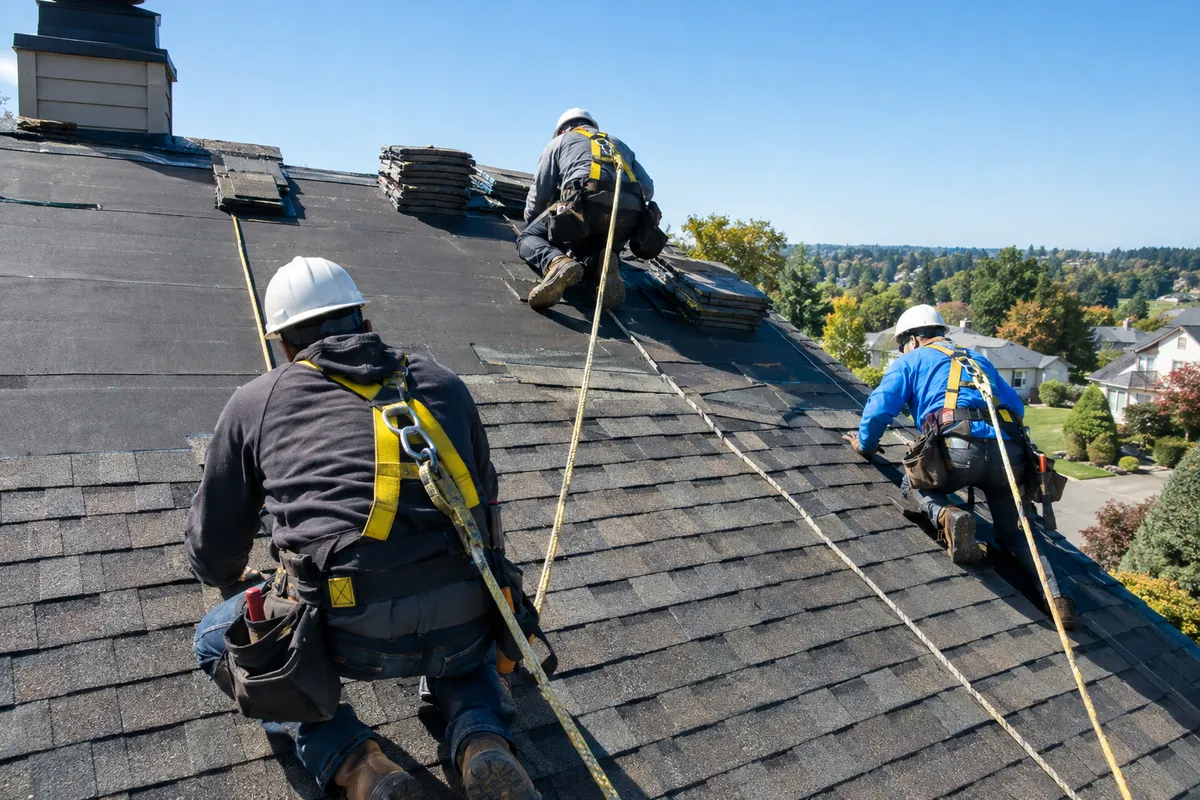

Gutter replacement makes sense when your gutters sag, separate at the seams, leak, or overflow even after cleaning. Professional replacement typically runs from about $600 to $4,100, with an average near $2,300, according to Forbes Home. The right price for your house depends on how many feet of gutter you have, the material, and how hard the roofline is to reach. The best time to do it is alongside roof or siding work, when the crew already has access to the edge of your roof. If you live in Northern Virginia, our gutter installation and repair service starts with a free, photo-documented inspection and a written proposal, so you see what is wrong before you decide.
TL;DR
- Replace gutters, rather than patching them, when they sag, pull away from the fascia (the board behind them), leak at many seams, or rust through.
- Budget about $10 to $25 per linear foot installed for seamless gutters, plus $1 to $2 per foot to remove the old ones.
- Gutters must slope toward the downspouts and carry water at least 5 feet from your foundation, or even new gutters will fail.
- Replace gutters with your roof or siding when you can: the edge of the roof is already open and any rotten fascia is easier to fix.
- Ask for a written proposal that lists footage, material, downspouts, fascia repair, and warranty terms before you sign.
Table of Contents
- Repair or replace: how to decide
- What gutter replacement costs
- Choosing materials and style
- Sizing and drainage: where new gutters succeed or fail
- How replacement is done, step by step
- Replace gutters with your roof or siding
- Siding replacement: when it belongs in the same plan
- What to check in a gutter or siding estimate
- Promo: a free inspection before you decide
- Our perspective
- Keeping new gutters working
- FAQ
- Sources
Repair or replace: how to decide
A small problem in one spot is a repair. A system-wide problem is a replacement. Walk around your house during or right after a hard rain and look at the gutters from the ground. Then use this list.
Repair is usually enough when:
- One seam drips and the rest of the run is straight and solid.
- A single hanger has loosened.
- A downspout is clogged or has come apart at one joint.
Replacement is usually the better choice when:
- The gutter sags or holds standing water. Water that sits in a gutter means the slope is wrong or the metal has bent.
- Seams leak in several places, even after resealing.
- You see rust holes, cracks, or flaking finish along long stretches.
- The gutter has pulled away from the house, or fasteners keep working loose.
- You see water stains on siding, soil washed out beside the foundation, or damp in the basement or crawl space after rain.
- The fascia behind the gutter is soft or stained. Replacing the gutter without fixing the board behind it just hangs new metal on rot.
The last sign matters most. Gutters protect more than the roof edge. When they fail, water runs down the siding and collects at the foundation. If you are unsure whether you are looking at a repair or a replacement, a free inspection with photos answers it with pictures of the problem areas, not a guess.
For related warning signs on the roof itself, see our guide to signs you need a new roof in Northern Virginia and our early roofing problem checklist.
What gutter replacement costs
Two published ranges give a useful frame. Forbes Home puts professional gutter installation or replacement at $600 to $4,100, with an average of about $2,300. It also lists about $1,600 for aluminum, steel, or vinyl on a standard-sized roof. Removing old gutters adds $1 to $2 per linear foot, and fascia or soffit replacement ranges from $1,300 to $5,100.
Per foot, RemodelingExpense’s 2026 calculator shows seamless gutters at $10 to $25 per linear foot installed. Seamless aluminum runs $10 to $18 per foot, heavier gauge $14 to $22, and complex two-story rooflines $18 to $25 or more. Most 200-foot projects land around $2,000 to $5,000.

A worked example
Say your house has 150 feet of gutter, which is common for a mid-sized two-story home. At $10 to $25 per foot, the installed range is $1,500 to $3,750. Removing the old gutters at $1 to $2 per foot adds $150 to $300. If a section of fascia has rotted, add that repair on top. Your own total depends on measured footage and your roofline, so treat these numbers as a range to check a proposal against, not a quote.
For a line-by-line view of what moves gutter prices, this gutter replacement cost breakdown is a helpful companion read. Our own overview of what homeowners pay covers the Northern Virginia side.
What changes the price
- Linear footage. More feet means more material and more labor.
- Material and thickness. Heavier-gauge metal costs more per foot.
- Roofline complexity. Many corners, bays, and dormers mean more miters (angled joints) and more seams.
- Height and access. Two-story work takes more time and safety equipment.
- Old gutter removal and disposal. Usually priced per foot.
- Fascia repair. Rotted boards must be replaced before new gutters go up.
- Local labor rates. These differ by region.
Choosing materials and style
The common choices for houses are vinyl, aluminum, steel, and copper. This Old House reports vinyl at $11.92 to $34.41 per foot and aluminum at $13.17 to $34.52. Vinyl is the least expensive and the most DIY-friendly, but it can turn brittle in extreme cold and intense sun. Seamless gutters cost more and require professional installation, because they are formed to length on site from a continuous piece of metal. That also means fewer seams, and seams are where most leaks start.
Two more choices come up in nearly every estimate:
- Shape. K-style gutters have a flat back and a decorative front. Half-round gutters have a rounded profile. Confirm which one the proposal specifies.
- Width. The Home Depot’s installation guide explains that gutters are usually 5 or 6 inches wide, and that steeper roofs and heavy-rain areas call for wider gutters and larger downspouts.
If you want help matching the material to your home, our post on picking the best gutters for your Fairfax home walks through it.

Sizing and drainage: where new gutters succeed or fail
A gutter is only as good as the path it gives the water. The EPA-backed Building America Solution Center gives specific targets:
- Slope the gutter at least 1/16 inch per foot of run so water travels toward the downspout.
- Place downspouts every 20 to 50 feet, allowing 1 square inch of downspout cross-section for every 100 square feet of roof.
- Carry water away from the building with lateral piping that extends at least 5 feet from the foundation, sloped at a minimum of 5/8 inch per foot.
The same guide explains the logic. A larger gutter moves more water only if enough downspouts drain it. The outlet should also empty onto ground that slopes away from the house, so water cannot run back toward the foundation. A splash block at the end of the pipe controls erosion.
Family Handyman adds practical rules. Runs of 40 feet or more should slope down both directions from the middle, with a downspout at each end. Large roof areas or regions with torrential rain may need oversized 3-by-4-inch downspouts.
These details are what separate a gutter that looks good from one that works. When you compare proposals, they should state the number and location of downspouts and where the water goes after it leaves the pipe.
How replacement is done, step by step
Here is the general sequence, based on the process Forbes Home describes, with what to watch at each step.
- Measure and plan. Total the linear footage, count corners and downspout locations, and choose material, gauge, color, and profile. Where it goes wrong: a rough estimate from the ground that misses a bay window or a dormer, which changes the price later. This is why we start with a free inspection that is documented with photos.
- Remove the old gutters and downspouts. Old gutters come off in sections. Where it goes wrong: the debris is left in the yard, or old fasteners are left in the fascia.
- Check and repair the fascia. Replace any rotten boards before anything new goes up. Where it goes wrong: this step is skipped to hold the price down, and new hangers pull out of soft wood within a season or two.
- Mark the slope. Snap a line so the gutter pitches toward each downspout. Where it goes wrong: a gutter that looks level but holds water. Check the slope against the targets above.
- Build and hang the gutter. Seamless gutter is formed to length. Sectional gutter is assembled in 10-foot pieces with slip-joint connectors. Hangers go in at regular spacing, and The Home Depot’s guide gives 18 to 24 inches depending on snow load. Where it goes wrong: wide hanger spacing leads to sagging under ice or leaf weight.
- Seal the outlets and connect the downspouts. Forbes says to use gutter sealant, not ordinary caulk, at the drop outlet. Add extensions or piping to carry water away from the foundation.
- Clean up and walk through. Magnetic sweeps for nails, a final look at every joint, and ideally a test with a hose.
Forbes notes most one-story homes take a day or two, and that two-story work is safest left to professionals. Ladders, wet metal, and roof edges are a common source of homeowner injuries, so for anything above the first floor, hire it out.
Replace gutters with your roof or siding
Yes, gutters can be replaced as part of roof work, and it is often the smartest time to do it. When roofers tear off old roofing, the roof edge and fascia are exposed. Rotten wood is easier to see and fix, and new gutters then attach to a sound surface. Doing the jobs separately can mean working on the same edge twice.
If you are planning a new roof, ask for the gutter work on the same written proposal so you can see it as one scope, with one schedule and one set of terms. Our roof replacement service and gutter work are both offered in Northern Virginia, and every project is documented before, during, and after the work. If you are still deciding between a patch and a new roof, roof replacement vs. roof repair lays out the trade-offs.
If a storm damaged your gutters and roof together, start with our guide to what to do first after storm damage. Our storm damage restoration team handles emergency work.

Siding replacement: when it belongs in the same plan
Many homeowners who search for gutter replacement are also looking at siding, because the two protect the same walls. Failed gutters send water down the siding, and siding that is already failing makes any water problem worse.
Signs your siding needs replacing
Bob Vila says siding lasts anywhere from 20 to 100 years depending on the material. The warning signs it lists are:
- Cracking or rotting
- Bubbling paint
- Mold growth
- Fading
- Frequent repainting or repairs
- A sudden rise in energy bills
Mold or bubbling paint points to moisture trouble, and replacement is needed to eliminate it, not just a fresh coat of paint.
Material choices in brief
According to Consumer Reports, vinyl is the most widely sold siding. It is low in price, needs no painting, will not warp or twist, and resists insects and water. Fiber cement looks the most like real wood and is fireproof and insectproof. Wood is impact-resistant but vulnerable to rot, insects, and woodpeckers. Pick on the look you want, upkeep you will accept, and your budget.
What proper siding replacement involves
The Building America Solution Center describes the sequence for an existing wall:
- Remove the old cladding and trim.
- Inspect the water-resistive barrier (the layer behind the siding that sheds water) and the flashing (the metal or membrane that directs water out around windows and doors). Check for moisture damage, especially at windows and doors.
- Find and correct the source of any damage.
- Install or repair the barrier and tie the flashing into it.
- Install the new siding to the manufacturer’s requirements.
The key point: new siding over an unrepaired leak hides the problem instead of ending it. Siding and gutters are both exterior services we offer, and you can ask about both through our services page.
What to check in a gutter or siding estimate
Before you sign, confirm that the written proposal covers these items. This list follows the pre-signing checklist from RemodelingExpense:
- Total linear footage
- Material, gauge, color, and profile
- K-style or half-round shape
- Number and placement of downspouts
- Hanger spacing and fastening method
- Corner miters and splash blocks
- Old gutter removal and fascia repair priced separately
- Written warranty terms for leaks, sagging, finish, and workmanship
Two more things to look for in any exterior contractor’s paperwork: change orders in writing, so the price does not drift, and a closeout package. Our process includes written change orders and a documented closeout with lien waivers (documents confirming that suppliers and subcontractors have been paid and cannot claim against your home) and warranty delivery. Every proposal also comes with good, better, and best options, so you can see the price and the difference in each tier.
Promo: a free inspection before you decide
Esteam Roofer handles roof replacement, roof repair, storm damage restoration, metal and flat roofing, gutters, and siding for homeowners in Fairfax, Arlington, McLean, Oakton, Springfield, Centreville, and the rest of Northern Virginia. Every project begins with a free, photo-documented inspection and a written proposal with good, better, and best options.

If your gutters are sagging, leaking, or pulling away, request your free inspection and see the exact condition of your gutters, fascia, and roof edge in photos before you spend anything. You can also browse our recent projects.
Our perspective
We think most gutter failures are really edge-of-the-roof failures. The gutter is the part you see, but the fascia, the slope, the downspout count, and where the water lands decide whether it works.
That is why we begin with a photo-documented inspection instead of a number over the phone. When you can see the sagging section, the soft board, and the pooled water in pictures, you can judge the proposal on its facts.
We also believe gutters, roof, and siding are best planned together. One written proposal with good, better, and best options, written change orders, and a documented closeout with lien waivers and warranty delivery keeps a multi-part exterior project clear from the first photo to the last.
Esteam
Keeping new gutters working
New gutters still need basic care. Our guide on keeping gutters flowing in Fairfax and the roof maintenance checklist for Northern Virginia cover seasonal habits. The short version: clear debris in fall after the leaves drop, check downspout outlets after heavy storms, and look at the slope and fasteners each year. Doing it early also gives you time to book repairs before winter.
FAQ
Should I replace 20-year-old gutters?
Not automatically. Age matters less than condition. If a 20-year-old run is straight, drains well, and has no rust holes or leaking seams, it may keep working. If it sags, leaks at many seams, or pulls from the fascia, replacement is the better value than repeated patching.
Do roofers typically replace gutters?
Many roofing companies do, because the gutters attach at the roof edge. At Esteam Roofer, gutter installation and repair is one of our listed services alongside roofing. Ask for gutter work on the same written proposal as the roof so the scope and warranty are in one place.
What is the average cost of gutters for a 2,000-square-foot house?
Square footage of the house is a poor guide, because gutters are priced by the linear foot of roof edge. Forbes Home gives an average of about $2,300 for professional installation, and RemodelingExpense shows $10 to $25 per linear foot installed for seamless gutters. A measured footage and a written proposal give you your real figure.
How long does gutter replacement take?
Forbes Home says most one-story homes take a day or two. Two-story homes, complex rooflines, and fascia repairs can add time. Your proposal should state the expected schedule.
Sources
- Gutters and Downspouts, Building America Solution Center
- How To Install Or Replace Gutters, Forbes Home
- Seamless Gutter Cost: 2026 Installed Price Calculator, RemodelingExpense
- Gutters: How To Choose, Install and Clean Them, This Old House
- How to Install and Replace Rain Gutters, The Home Depot
- Gutter Replacement: How to Install Gutters, Family Handyman
- When to Replace Siding, Bob Vila
- Siding Buying Guide, Consumer Reports
- Vinyl Siding with Integrated Rigid Foam for Existing Walls, Building America Solution Center