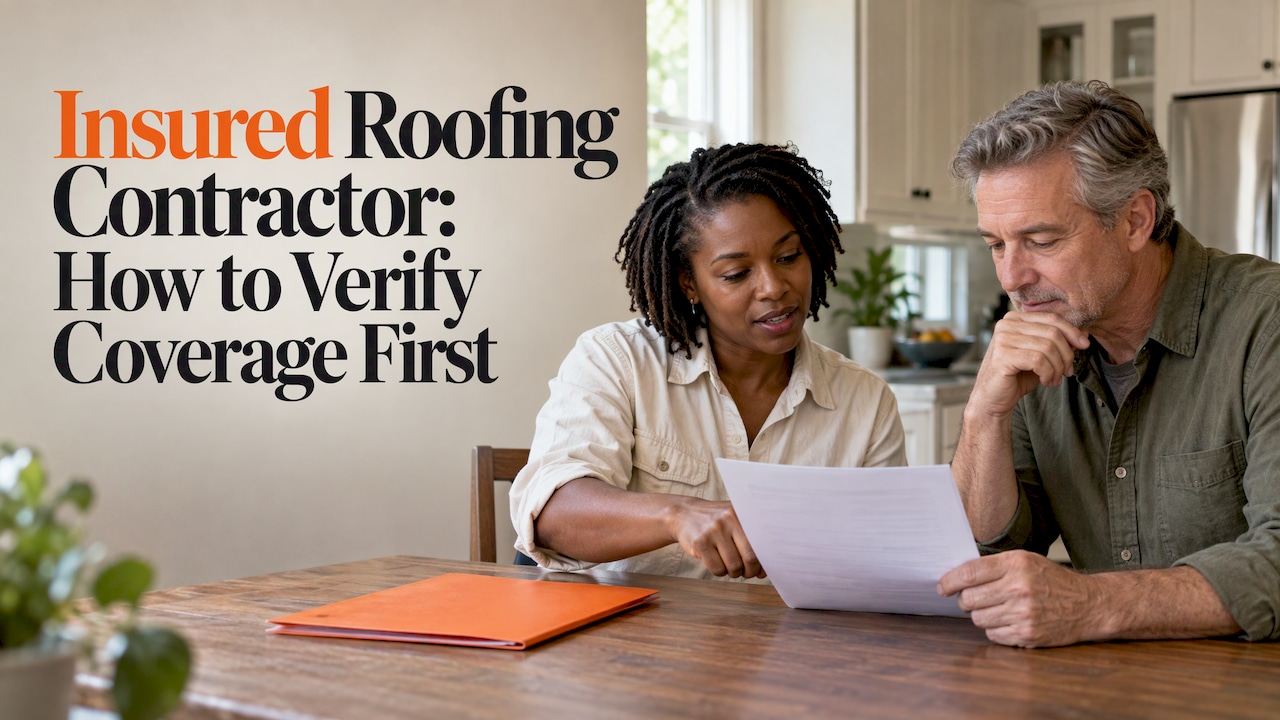
An insured roofing contractor carries active general liability insurance and, if the company has employees, workers’ compensation, and you can confirm both with the insurer before anyone climbs onto your roof. A sticker on a truck or a line on a website does not prove it. A certificate of insurance, checked by phone against the policy dates, does. This guide shows what to ask for, how to verify it, and how to keep a roofing job from becoming your financial problem. If you live in Fairfax County or elsewhere in Northern Virginia, our roof inspection starts with a free, photo-documented review and a written proposal, which gives you the paperwork trail this article describes.
TL;DR
- Insured means two things at minimum: general liability (damage to your property or injury to others) and workers’ compensation (injury to the crew) if the company has employees.
- A commonly recommended general liability minimum is $1 million per occurrence and $2 million aggregate.
- Ask for the certificate, then call the insurer or agent listed on it to confirm the policy is active for the whole job.
- Many homeowners’ policies exclude or limit damage caused by contractors, so the roofer’s coverage is your first line of protection.
- Put the scope, payment schedule, change orders and warranty in writing before work begins.
Table of Contents
- What “insured” means for a roofer
- Why it matters to your wallet
- Licensed is not the same as insured
- How to verify a roofer’s insurance, step by step
- What a certificate does not prove
- Insurance claims after a storm: extra care
- Do not help the crew
- What belongs in the written proposal and contract
- Where we fit in
- Our perspective
- Frequently asked questions
- Sources
What “insured” means for a roofer
Roofing is one of the riskier jobs a contractor does at your home. Crews work at height, carry heavy bundles of material, use torches or nail guns, and open your roof to the weather. When something goes wrong, someone’s insurance has to pay. The question is whose.
Here are the coverages that matter, in plain terms:
- Commercial general liability. Pays for bodily injury to people who are not employees and for damage to your property, and covers legal defense. The New Hampshire Insurance Department says to look for products and completed operations coverage, which responds to problems that surface after the job is finished, such as a leak traced to the work.
- Workers’ compensation. Pays medical bills and lost wages for a crew member hurt on the job. Requirements differ by state, but it is mandatory for employers of a certain size in most places.
- Other policies. Depending on the job, commercial auto, builders risk, professional liability and umbrella (excess) coverage can also apply. For a typical residential roof, liability and workers’ compensation are the two you check first.
A commonly recommended general liability level is $1 million per occurrence and $2 million aggregate. “Per occurrence” is the most the policy pays for a single incident. “Aggregate” is the most it pays across all claims in the policy period.
Why it matters to your wallet
The stakes are concrete. The New Hampshire Insurance Department explains that if a contractor has no workers’ compensation and a worker is injured on your property, you could be held responsible for medical expenses, lost wages and related legal costs. The same page notes that many standard homeowners’ policies exclude or limit damage caused by contractors, which can leave you paying out of pocket.
In practice that means a dropped bundle of shingles through a skylight, a fire from a torch on a flat roof section, or a fall from a ladder should be handled by the contractor’s insurer. Verifying coverage before the job is what keeps it that way.
The National Roofing Contractors Association also advises homeowners to ask for copies of both the liability and workers’ compensation certificates and to make sure both stay in effect for the duration of the job. A policy that was active in March and lapsed in June does nothing for a roof replaced in July.

Licensed is not the same as insured
Homeowners often treat a license as proof of insurance. It is not. The National Association of Insurance Commissioners (NAIC) stresses that a licensed contractor is not automatically an insured one. “Licensed” generally means the contractor met competency requirements. “Registered” only means contact information was given to a government authority.
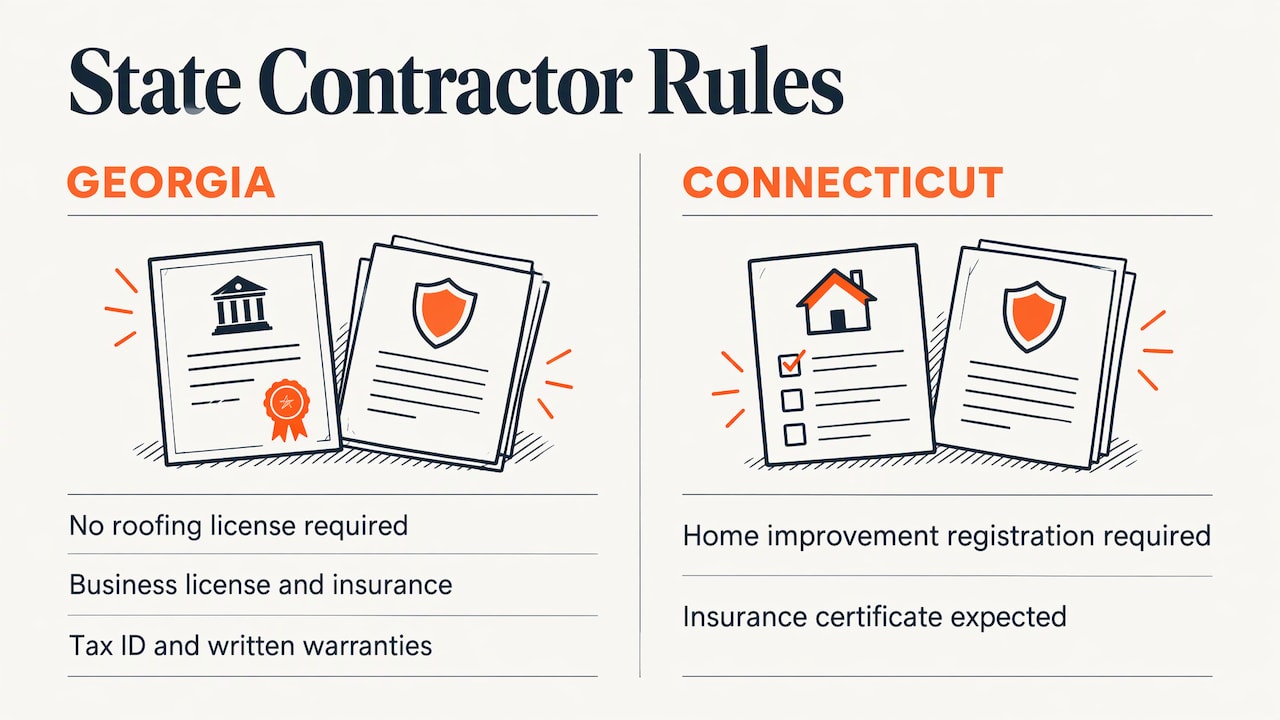
Rules vary a great deal by state. Georgia, for example, does not require a roofing license, though its Attorney General’s consumer office says a legitimate company should still provide a business license, workers’ compensation, general liability insurance, a tax ID number and written warranties. Connecticut requires home improvement contractors to register and expects them to produce an insurance certificate. Because of this patchwork, you cannot rely on what a state requires. Check the insurance yourself.
In Virginia, we cover the license and contract side in our guide to hiring a roofer in Virginia. Use it alongside the insurance steps below.
How to verify a roofer’s insurance, step by step
This takes about 15 minutes and should happen before you sign anything.
1. Ask for the certificate of insurance
A certificate of insurance (COI) is a one-page summary of a contractor’s policies. The NAIC advises getting proof of liability insurance showing the company’s name, phone number and policy number, plus proof of workers’ compensation and a current business license. Ask for these in writing, by email, so you have a copy.
Where it goes wrong: a certificate handed over on a phone screen or a photocopy with the name blacked out. You need the legal business name, which should match the name on your proposal and contract.
2. Read the dates and the names
Check three things on the certificate:
- The business name matches the contractor you are hiring.
- The policy period covers the entire job, including a start date weeks away.
- Both general liability and workers’ compensation appear, and the liability limits meet at least the $1 million and $2 million levels above.
3. Call the insurer or agent
This is the step people skip, and it is the one regulators keep recommending. The New Hampshire Insurance Department says to contact the insurer or agent to confirm the policy is active, in force and adequate. The Maryland Insurance Administration likewise tells homeowners to call the insurer to verify coverage. A certificate is a summary; a call confirms the policy behind it has not been cancelled.
4. Ask about subcontractors
Many roofing companies use subcontracted crews for tear-off or specialty work. The same New Hampshire guidance says to confirm subcontractors carry equal or greater coverage. Ask who will physically be on your roof and whether those workers are the company’s employees or a separate crew.
5. Confirm the business is real
The NRCA suggests checking for a permanent place of business, a phone number, a tax ID and a business license where one is required. A company with a local address you can drive to is easier to hold accountable if a claim comes up.
What a certificate does not prove
A certificate is useful, but it has limits. The standard ACORD 25 certificate form says it is issued as a matter of information only and does not amend, extend or alter the coverage in the policy. Being listed as the certificate holder does not make you an insured party under the policy.
Two practical takeaways for homeowners:
- The policy controls, not the certificate. If a specific exclusion worries you, ask the agent whether the policy contains it.
- If you want to be covered as an additional insured, that status comes from an endorsement on the policy, not from a box checked on the certificate. For a typical residential re-roof, the more practical protection is simply confirming active liability and workers’ compensation and keeping a written contract.
That last point is why the call to the insurer matters more than the piece of paper.
Insurance claims after a storm: extra care
After hail or wind, door-to-door contractors appear quickly. The Maryland Insurance Administration warns that fraudsters often arrive fast, sometimes traveling from state to state, and advises homeowners to find out where unfamiliar contractors are from and never to pay the full amount before the work is complete.
Three storm-specific points:
- File your claim first. The NAIC urges homeowners to file the insurance claim before hiring a contractor so the insurer verifies the repairs that are needed.
- Be careful with an assignment of benefits. The Maryland guide explains that an assignment of benefits transfers some or all of your rights under the policy to a third party such as a contractor, and signing one can mean losing control over the claim settlement, including the right to receive payment. Read any such form fully and talk to your insurer before signing.
- Nobody is “FEMA certified.” The NAIC notes FEMA does not certify or endorse contractors, so any contractor claiming that is not telling the truth.
For the sequence of what to do after damage, see our storm damage and insurance claim steps and the first 48 hours checklist. If water is coming in now, emergency tarping protects the house while the paperwork moves.
Do not help the crew
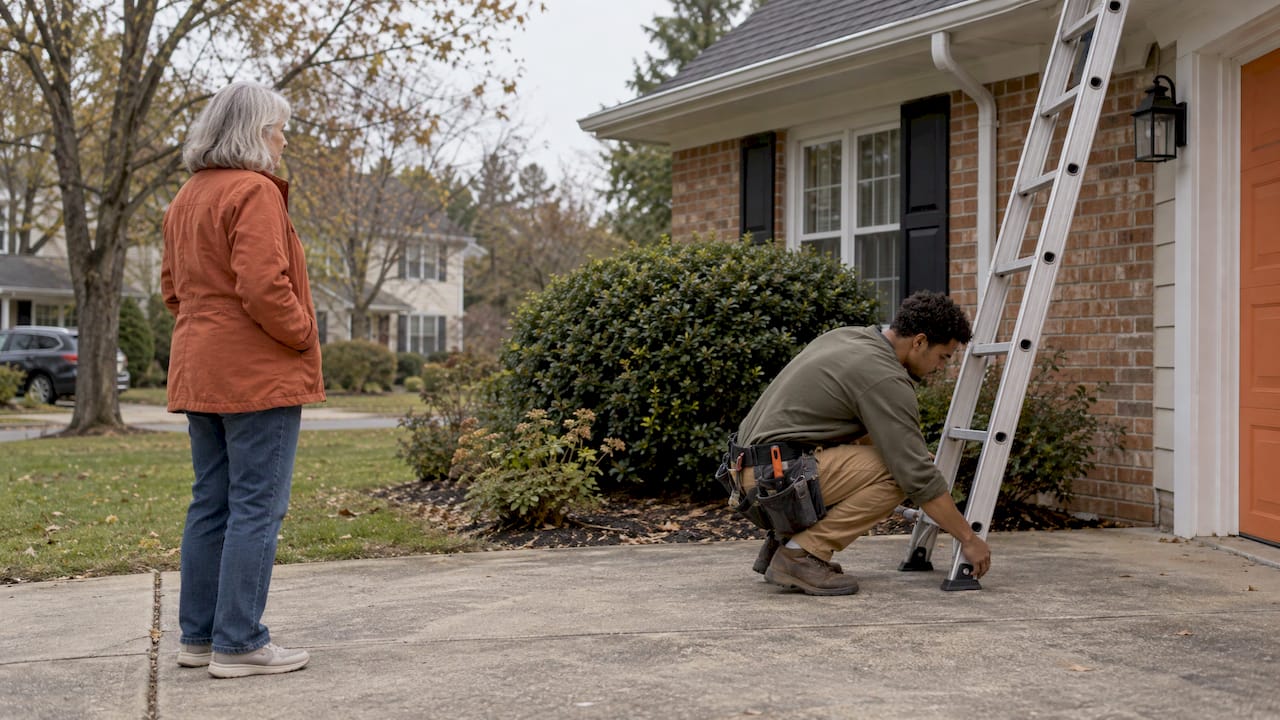
It sounds friendly to lend a ladder or hold it steady. Insurance professionals advise against it. The North Texas Roofing Contractors Association explains that a homeowner who lends tools or assists workers can affect whether the contractor’s insurance responds to a claim. Keep family and pets away from the work area and let the crew handle equipment.
What belongs in the written proposal and contract
Insurance protects you from accidents. A good contract protects you from misunderstandings. The Better Business Bureau says a detailed proposal should list materials, scope of work, flashing and ventilation work, start and completion dates, payment procedures, warranty length and who hauls away old materials.
A practical checklist before you sign:
- Legal company name, address and phone number on the proposal.
- Exact materials by brand and product line, and the number of layers being removed.
- Start and expected completion dates.
- A payment schedule tied to progress, with the final payment due only after the work is complete.
- How changes are handled. If the crew finds rotted decking, you want the extra cost in a written change order before the work happens, not a surprise on the final invoice.
- Warranty terms for both materials and workmanship, in writing.
- Cleanup and debris removal.
At closeout, ask for lien waivers. A lien waiver is a document in which a contractor or supplier confirms they have been paid and give up the right to place a claim on your property. It keeps an unpaid supplier from coming after your home for a bill you already settled.
Where we fit in
The steps above are the routine we recommend to any homeowner, and they are how we run projects in Fairfax, Arlington, McLean, Oakton, Springfield and across Northern Virginia. Every project starts with a free, photo-documented inspection and a written proposal laying out good, better and best options, so you can compare materials and cost on paper. Work is documented before, during and after. Changes go through written change orders, and the closeout includes lien waivers and warranty delivery.
If you are weighing a repair or a full replacement, start with Roof Replacement or Roof Repair. Storm-related damage is handled under Storm Damage Restoration.

To see what finished work looks like locally, browse our Northern Virginia project photos, or contact us for a free inspection.
Our perspective
Homeowners rarely think about insurance until something goes wrong, and by then the choices are limited. We would rather you ask the right questions at the start of the process, and we think a roofing project should be easy to follow on paper.
That is why every job we take begins with a free, photo-documented inspection and a written proposal with good, better and best options. You see the condition of your roof in pictures, you see what each option includes, and you decide with the facts in front of you.
We document the work before, during and after. If something changes mid-project, it goes into a written change order, so nobody is guessing about scope or price. When the job is done, the closeout includes lien waivers and warranty delivery, which means you finish with the paperwork in hand, not just a new roof.
A roof is the largest barrier between your family and the weather. Hiring well means checking the details early, keeping everything in writing, and working with a team that treats documentation as part of the job.
Esteam
Frequently asked questions
How much insurance should a roofing contractor carry?
A commonly recommended level for general liability is $1 million per occurrence and $2 million aggregate. Contractors with employees should also carry workers’ compensation, where state law requires it. Larger or more complex roofs can justify a conversation about higher limits.
Is a roofing license the same as insurance?
No. A license generally shows a contractor met competency or registration requirements, while insurance is a separate policy from an insurer. The NAIC makes this distinction clearly, so verify each one separately.
Who pays if a roofer damages my home?
If the contractor carries active general liability insurance, their insurer should handle covered property damage. If they do not, you may be left to pay or to rely on your own policy, which can exclude or limit contractor-caused damage. Talk with your own insurance agent if you are unsure how your policy treats contractor work.
When should I verify insurance: before the estimate or before signing?
Verify before you sign, and confirm again that the policy covers the planned start and finish dates. Insurance paperwork should sit alongside the written proposal, so you can review everything at once.
Should I file my insurance claim before hiring a roofer?
For storm damage, yes. The NAIC advises filing first so your insurer can verify the needed repairs. Then compare written proposals with the insurer’s findings in hand.
Sources
- How to Verify If Your Contractor Has the Right Insurance, New Hampshire Insurance Department
- Post-Disaster Claims Guide, Maryland Insurance Administration
- How can I avoid getting scammed by a contractor? NAIC
- Selecting a Contractor, National Roofing Contractors Association
- How do I know if a roofer is reputable or not? Georgia Consumer Protection
- After the Storm, Hire the Right Contractor for the Job, Connecticut Department of Consumer Protection
- What Homeowners Need to Know About Liability Insurance When Hiring a Roofing Contractor, NTRCA
- BBB Tip: Roofing contractors
- Certificate Holder vs Additional Insured