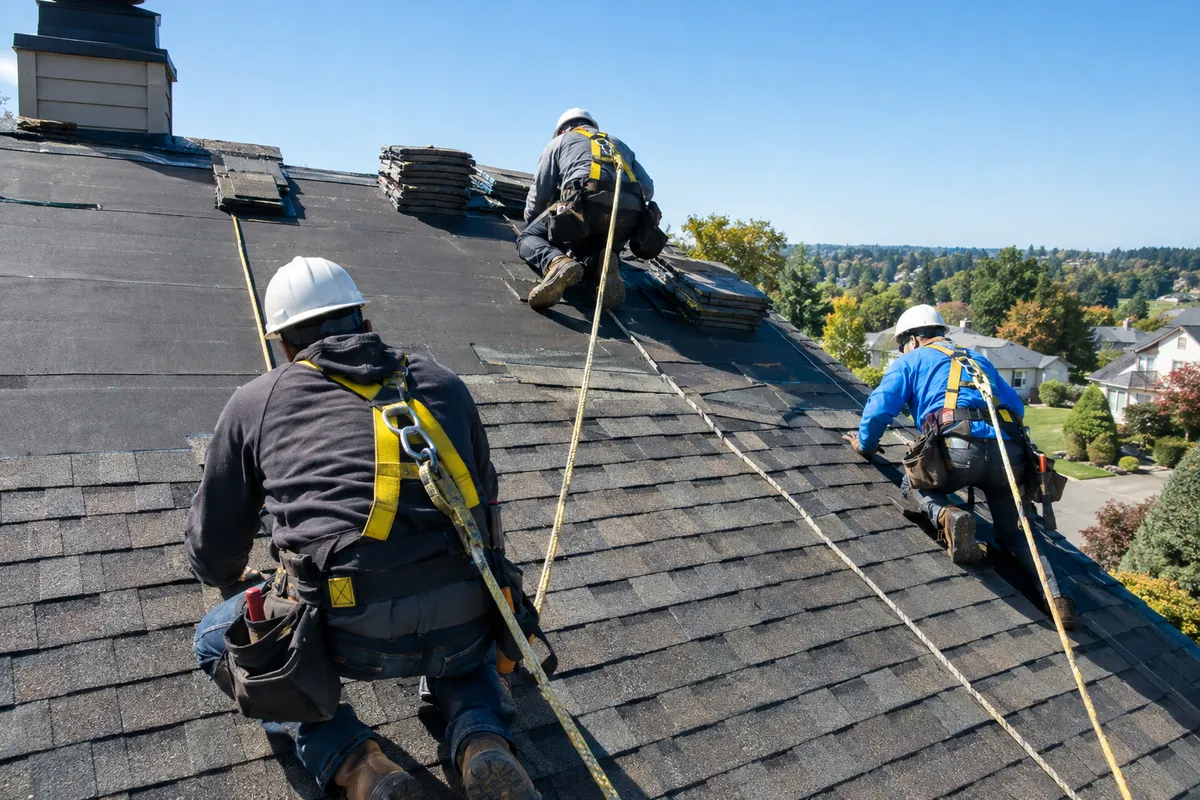

A sagging gutter is a sign that something is holding it down or no longer holding it up: trapped water and debris, hangers that have pulled loose, or a slope that has shifted. The repair is straightforward once you know which one it is, but a gutter that looks fixed and still ponds water will keep failing. We start every gutter job with a free, photo-documented inspection and a written proposal, so you see the cause and the options before any work begins.
TL;DR
- Most gutters sag because trapped water and debris add weight, or because hangers are loose, bent or spaced too far apart.
- A repaired gutter must still slope toward the downspout, about 1/4 inch per 10 feet. Without that slope, water stands and the sag returns.
- Minor sagging in one spot can often be repaired. Rust, cracks or sagging in several places usually points to replacement.
- Work from a ladder is where the real risk sits. Long runs, second-story edges and fascia damage are jobs for a contractor.
- In Northern Virginia, we offer free inspections and written proposals for gutter installation and repair.
Table of Contents
- What makes a gutter sag
- Read the sag before you fix it
- Repair, reattach or replace
- How the repair is done
- Check the slope, because that is what decides the result
- Ladder safety comes first
- When to call a professional
- Keep them from sagging again
- Our perspective
- Get your gutters inspected and repaired
- FAQ
- Sources
What makes a gutter sag
A gutter is a long, light channel hanging from your roof edge. It is built to carry water, not to carry a load. When something adds weight or removes support, the lowest-supported stretch drops.
Weight from debris and standing water. This Old House lists clogs that trap water and add weight as the first cause. Wet leaves, shingle grit and pine needles hold water in the channel, and water is heavy. In Fairfax County, with mature oaks and maples over many roofs, this is the cause we would check first.
Installation problems. The same source points to inadequate fasteners, incorrect hanger spacing and missing slope. Forbes Home says hangers should be no more than 3 feet apart, while This Old House recommends no more than 2 feet. If your hangers are spaced wider than that, the gutter was under-supported from day one.
Weather and age. Temperature swings, heavy snow and ice dams push and pull on gutters year after year. Old spike-and-ferrule fasteners work loose in the wood, and hangers bend or rust.
Hidden damage behind the gutter. If the screws keep pulling out, the fascia board (the trim board the gutter attaches to) may be soft from water. New hangers in rotten wood will not hold. This is the point where a gutter problem becomes a roof-edge problem, and it is worth having the whole edge looked at.

Read the sag before you fix it
Walk the perimeter of the house in dry weather and, if you can, again during a steady rain. Note what you see.
- A dip in one spot with debris visible: likely weight. Clearing and re-securing may be enough.
- The gutter pulling away from the fascia at the top: hangers or fasteners have failed, or the board behind them is damaged.
- Sagging evenly along a long run: hangers are too far apart or too light for the span.
- Water standing in the channel after rain has stopped: the slope is wrong, even if the gutter looks level to the eye.
- Water spilling over the front edge or behind the gutter: the gutter has tilted or pulled off the fascia, which sends water into the eave and siding area.
- Peeling paint, stains or soft trim near the gutter: water has been getting where it should not for some time.
Photograph each problem area. A dated photo record makes it easy to compare before and after, and it is the same approach we take on site.
Repair, reattach or replace
The right call depends on how much of the system is affected. This Old House says minor sagging may be repairable, while rusting, cracking or sagging in multiple areas may make replacement more cost-effective.
| What you see | Usual answer |
|---|---|
| One short sagging section, sound metal | Reattach with new hangers, correct the slope |
| Hangers bent, loose or spaced too wide | Replace hangers, add more along the run |
| Fasteners pulling out of soft wood | Repair the fascia first, then rehang |
| Rust, cracks or splits in the channel | Replace the damaged section or the run |
| Sagging in several places around the house | Replace the system, often as seamless gutters |
| Sagging after storm or tree damage | Inspection of gutters and roof edge together |
If you are weighing replacement, our guide to what gutter replacement costs in 2026 explains what drives the price, and choosing the best gutters for a Fairfax home covers materials and styles.
How the repair is done
Here is the routine for reattaching a sagging section. It is useful to know even if you hire it out, because it shows what a proper job includes and where a rushed one goes wrong.
- Clear the gutter and downspout first. Remove debris by hand, flush the channel and check that the downspout runs freely. Family Handyman describes clearing a downspout by disconnecting the elbows and pipe, shaking out debris and hosing the pieces. A gutter that is still full cannot be set to the right slope.
- Remove failed brackets and spikes. This Old House starts by taking out the old brackets, then holding the gutter in place with a screw through the rear center.
- Reset the pitch. Adjust the gutter so it falls toward the downspout and secure it. Where this goes wrong: the gutter is lifted until it looks level, not until it drains. Eyeballing the slope is the most common reason a repaired gutter sags again.
- Mark the rafter tails. These are the ends of the roof rafters behind the fascia, the solid wood that can actually hold weight. Heavy-duty brackets go in front of them, and each bracket is screwed through the fascia into a rafter tail, per the same This Old House repair guide.
- Add support where the sag was. This Old House suggests replacing damaged or bent hangers and adding straps in problem areas. Where it goes wrong: new hangers placed in the old, enlarged holes, which have nothing left to grip. Forbes Home notes that when driving new fasteners, new holes should be drilled above the old ones to preserve slope.
- Reseal joints and test. Scrape off old sealant, dry the surface and apply new gutter sealant, then let it cure as directed (Family Handyman). Run water through the gutter and watch where it goes.
The published materials list is short: a drill/driver, patch kit, sealant, ladder, replacement brackets or hangers, safety glasses, screws and gloves. This Old House puts the materials and time for a do-it-yourself repair at roughly $25 to $200 and 2 to 4 hours, depending on gutter type and the extent of the damage. That range covers materials for a small, simple repair. It does not cover hidden fascia damage, long runs or a second story.

Check the slope, because that is what decides the result
Slope is the part most homeowners cannot judge by eye. InterNACHI’s inspection guidance states that gutters should slope toward the downspout at about 1/16 inch per foot, which is roughly 1/4 inch for every 5 to 10 feet. Too little slope will not move water well. Much more makes water rush and overflow at end caps and corners. This Old House gives the same working figure: at least 1/4 inch per 10 feet, checked with a level or with running water.
A worked example: on a 30-foot run draining to one end, the downspout end should sit about 3/4 inch lower than the far end at that 1/4-inch-per-10-feet rate. If you measure less, water will pool in the middle.
After any repair, check three things:
- Water drains toward the downspout with no standing water left in the channel once the flow stops. Inspectors look for exactly that, standing water away from the downspout.
- No water drips from joints or runs behind the gutter.
- Water leaves the downspout and flows away from the foundation.
If puddles remain, the slope is off, and tightening more screws will not fix it.
Ladder safety comes first
Most of the cost in a gutter job is not the parts, it is working at height. If you decide to do light work yourself, follow the basics.
- Inspect the ladder before each use and set it on dry, level ground. The Massachusetts ladder safety guidance recommends the base sit 1 foot out for every 4 feet of height.
- Have someone steady the ladder, keep three points of contact and do not work from the top three rungs.
- Never lean out sideways to reach farther. Move the ladder.
- If you use an extension ladder to reach a roof edge, it should extend 3 feet above the edge, per the same guidance.
Family Handyman quotes a ladder-safety expert who says most ladder injuries happen at less than 6 feet, so even one-story work may warrant a professional. This Old House likewise advises hiring a pro if you are uncomfortable on a ladder. Wet leaves, uneven ground and a gutter that may give way under your weight all raise the risk, and a sagging gutter should never be used as a ladder support.
When to call a professional
Forbes Home advises calling a professional when the sagging spans a large part of the house, is high up or is damaged beyond repair. In practice, that covers:
- Two-story homes or any run you cannot reach safely from the ground.
- Sagging in several areas, which points to a system-wide problem.
- Soft or rotted fascia or visible water damage at the eaves.
- Seamless gutters, which are formed to length on site and cannot be patched into shape at home. Angi’s guidance, summarized by Forbes, notes this is something do-it-yourselfers generally cannot do.
- Gutters that sagged after a storm, a fallen limb or an ice dam. The roof edge and shingles may have been hit too, and our storm damage guide explains what to do first.
Gutter trouble is also an early signal for the roof. Overflow at the eaves, shingle grit in the channel and peeling fascia paint often show up together. Our posts on spotting common roofing problems early and signs you need a new roof in Northern Virginia help you tell the difference.
Keep them from sagging again
- Clean on a schedule. Family Handyman suggests cleaning about once a year, depending on tree cover. Homes under heavy canopy do better with more frequent checks, especially after leaf drop. Our post on keeping gutters flowing in Fairfax walks through the routine.
- Watch the downspouts. A blocked downspout turns a gutter into a bucket.
- Check after storms and winter. Look for gaps, tilt and pulled hangers.
- Fix small drips early. A leaking joint soaks the fascia, and soaked fascia loses its grip on every fastener.
Our perspective
We treat a sagging gutter as a symptom. The sag is what you see; the cause sits in the hangers, the slope, the fascia or the roof edge, and a repair that skips the cause comes back within a season or two.
That is why every project we take on begins with a free, photo-documented inspection and a written proposal with good, better and best options. You see the problem in pictures, you see what each level of repair involves, and you decide from a written scope instead of a verbal guess.
Once work starts, we document it before, during and after. If something changes, such as finding rot behind the gutter, it goes into a written change order so there are no surprises on the final invoice. At closeout you receive lien waivers and your warranty paperwork.
For a homeowner, that means a gutter that is hung to drain, fastened into solid wood and backed by paperwork you can file. We would rather you see the whole picture of your roof edge once than pay for the same sag twice.
Esteam
Get your gutters inspected and repaired
We repair and install gutters for homeowners across Northern Virginia, including Fairfax, Arlington, McLean, Oakton, Springfield and Centreville. If your gutters sag, pull away or hold water, our team can inspect them, photograph the cause and give you a written proposal. See our gutter installation and repair page, or start from our main site to request a free inspection.

If the sag comes with stained soffits, shingle damage or leaks inside, ask us to look at the roof edge too. Our roof inspection and roof repair services cover it in the same visit.
FAQ
Can I fix a sagging gutter by just adding screws?
Usually not. Screws driven into the same weak spots or soft fascia tend to pull out again. The gutter needs hangers placed into solid wood such as the rafter tails, and the slope has to be reset so water drains. A contractor can also check whether the board behind the gutter is sound.
How far apart should gutter hangers be?
Published guidance varies slightly. Forbes Home says no more than 3 feet apart, and This Old House recommends no more than 2 feet. Closer spacing gives more support, especially in areas with heavy leaf loads, snow or ice.
Why does my gutter hold water after I fixed it?
The slope is probably still off. The channel should fall toward the downspout at roughly 1/4 inch per 10 feet. Standing water away from the downspout is the sign inspectors look for. Resetting the hangers to the correct pitch is the cure, and a professional can set it with a level.
Should I repair or replace sagging gutters?
Repair fits a single section with sound metal and failed hangers. Replacement is usually the better value when there is rust, cracking or sagging in more than one area. Our free inspection and written proposal show the options side by side so you can compare them.
Is it safe to repair gutters myself?
Light work from a stable, level ladder with a helper is manageable for some homeowners. Falls from ladders are the main risk, and they happen even at low heights. For two-story homes, long runs or anything near damaged fascia, hire a professional.
Sources
- How To Fix Sagging Gutters, This Old House
- How To Repair a Gutter, This Old House
- How To Fix Sagging Gutters (DIY Guide), Forbes Home
- Easy Gutter Fixes You Can DIY, Family Handyman
- Inspecting Gutters and Downspouts, InterNACHI
- Ladder safety guidance, Massachusetts FACE program