
Most shingle damage can be repaired without a new roof: missing, cracked, punctured or wind-lifted shingles are usually fixed section by section. Repair stops making sense when damage spreads across several slopes or the roof is near the end of its life. The way to know which side you are on is a photo-documented inspection and a written proposal with measurements. At Esteam Roofer, every project starts with a free inspection and a written proposal with good, better and best options, so you decide with the facts in hand.
TL;DR
- Small tears, cracks, punctures, lifted shingles and missing shingles are normally repairable, and repairs can be limited to the damaged area.
- Repair usually fits a roof under about 15 years old with minor damage. Replacement is worth pricing when more than 20% to 25% of the roof is damaged.
- Most U.S. homeowners spend $400 to $2,000 on roof repairs, per AAA. A few missing shingles often cost a few hundred dollars.
- A good quote states what is repaired, in square feet, and how hidden deck damage will be handled through a written change order.
- Do not climb onto the roof yourself. Take photos from the ground, cover the interior, and call for an inspection.
Table of Contents
- What shingle damage can be repaired
- What a proper shingle repair involves
- What to do when a roof leak starts
- Repair or replace: how to decide
- What shingle roof repair costs
- How to read a repair quote
- Missing and blown-off shingles: what to do this week
- Get a free inspection and written proposal
- Our view: repair what is sound, and document everything
- FAQ
- Sources
What shingle damage can be repaired
Asphalt shingles are one of the easier roofing systems to repair. The Asphalt Roofing Manufacturers Association (ARMA) says in its February 2026 technical bulletin that the underlayment, starter strips, shingles and ridge caps can each be repaired independently, without disturbing a large area of the roof.
The repairs that bulletin lists as quick fixes cover most of what homeowners call about:
- Shingles punctured or damaged by windborne debris, such as a branch or hail, are replaced individually.
- Wind-damaged shingles that have lost their seal are resealed so they lie flat again.
- Backed-out fasteners, meaning nails that have worked upward, are corrected before they push through the shingle above.
- New penetrations, such as a vent or skylight, get new flashing. Flashing is the metal that seals the joint where the roof meets a pipe, chimney or wall.
Missing shingles are the most common reason people search for this. A missing shingle leaves the underlayment and nails exposed, and water can reach the deck underneath. Replace it quickly, even if you see no leak yet. Our guide to the top signs your roof needs repair before winter shows what else to look for from the ground.
Damage you cannot see from the ground
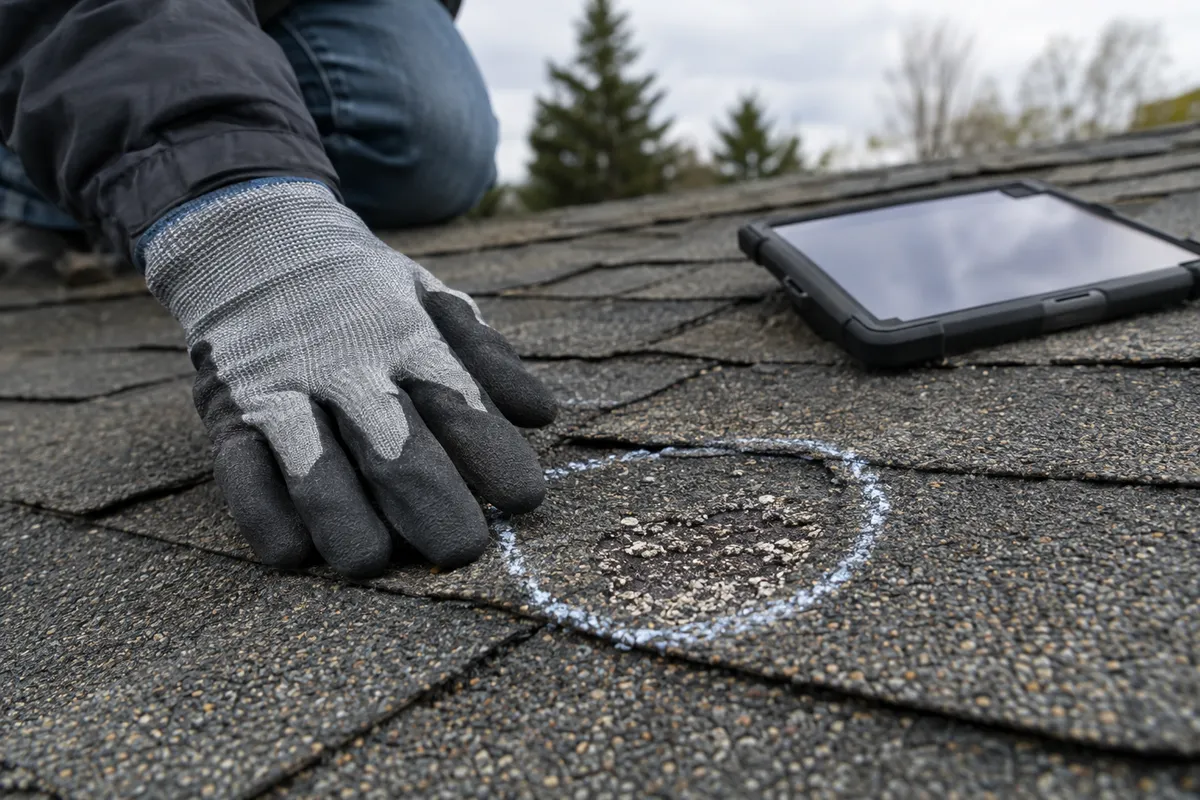
Storm damage is not always obvious. GAF’s technical bulletin on replacing storm-damaged shingles notes that impact points can show granule loss, cracks in the surface, an exposed fiberglass mat, or a weakened self-seal strip. Granules are the gritty coating that shields the shingle from sun. That is why a trained eye on the roof matters after a storm, even when the shingles look intact from the yard. Our storm damage roof guide covers what to do first.
What a proper shingle repair involves
You are paying a crew, not doing the work yourself, but knowing the steps helps you read a proposal and judge the finished job. A sound single-shingle repair generally goes like this:
- The crew lifts the shingles above the damaged one and removes the nails holding the damaged shingle.
- They slide a new shingle of matching type into place under the course above and fasten it with the correct nails.
- They reseal the surrounding shingles by hand. GAF’s bulletin says nails removed from neighboring shingles must be replaced and the surrounding shingles hand-resealed so the area is weather-tight.
- They check flashing, sealant and any exposed fasteners nearby.
Two details matter. First, the new shingle should match the existing product as closely as possible. Older roofs fade, so a perfect color match is not always possible. Second, a repair is only as good as the resealing and fastening around it.
Roofing cement smeared over a puncture is not a repair. ARMA warns it is a temporary fix, not a suitable long-term solution. If a contractor proposes only a coat of cement on a hole in the shingle, ask what permanent repair follows.
Why not do it yourself
Roof work is a fall risk. This Old House notes that roughly a third of construction fatalities are falls from roofs. The shingle itself is not the hard part. Footing on a pitched, sometimes wet and brittle roof is. If you find a problem, photograph it from the ground, protect the inside of the house, and have us look at it. Our roof repair service in Northern Virginia is built around exactly these jobs.
What to do when a roof leak starts
If water is already coming in, the first goal is limiting interior damage. ARMA’s bulletin says to start by placing buckets to catch water and keep it away from insulation and ceilings. A tarp over the damaged area of the roof is the next step, and it should be installed by someone equipped to work at height.

Once the water is controlled, find where it entered. The wet spot on the ceiling is often not directly below the roof opening, because water travels along framing before it drips. This guide on ceiling leak repair explains how to trace the source and handle the drywall afterward. For the roof side, read our walkthrough on what to do in the first hour of an emergency roof leak.
Take dated photos of the interior and exterior damage before anything is moved. If a storm caused it, you will want them for a claim. GAF notes that homeowners insurance typically covers roof damage from covered events such as certain weather, falling trees or fire, but not regular wear and maintenance. Bob Vila adds that many carriers expect damage to be addressed within a year of the weather event, so do not wait on storm damage. Call your insurer for the specifics of your policy.
Repair or replace: how to decide
This is the question behind most shingle roof searches. Three factors decide it: the age of the roof, how much of it is damaged, and whether the problem keeps coming back.
Age. AAA’s April 2026 guide says roofs under 15 years old with minor damage may need only repairs. It gives a 19-year-old roof with damage in several spots as a replacement candidate.
Extent. The same guide says replacement may make more financial sense when more than 20% to 25% of the roof is damaged. Signs include curling, cracking or missing shingles across multiple sections, daylight visible from the attic, and water damage or mold in several areas.
Pattern. Consumer Reports says in its roofing buying guide that leaks limited to a few spots can usually be stopped with a few replaced shingles or new flashing. Recurring leaks on a roof that is out of warranty mean a new roof is in order. It also considers replacing an out-of-warranty roof over 20 years old wise even without obvious damage.
Here is how that looks in practice:
| Situation | Usual direction |
|---|---|
| Roof under 15 years, a few missing or lifted shingles | Repair |
| Wind-lifted shingles on one slope, still sealed elsewhere | Repair and reseal |
| Cracked or curled shingles on several slopes | Price repair and replacement side by side |
| Granules piling up in gutters, brittle shingles | Replacement likely approaching |
| Roof near or past 20 years with repeat leaks | Replacement |
A note on layering over old shingles
Some homeowners ask about installing new shingles over the old ones. Fine Homebuilding reports in its guide to reroofing that reroofing can shorten the life of the new shingles by 20% to 40%. It is only acceptable over a single layer that is not lifting or curling, and manufacturers’ watertight warranties apply to full replacements, not reroofs. For most aging roofs, a tear-off is the stronger result.
We lay out the same trade-off in roof replacement vs. roof repair and in our guide to signs you need a new roof in Northern Virginia. If replacement is where you land, you can also compare asphalt with metal roofing for NoVA homes.

What shingle roof repair costs
Prices vary with the roof and the damage, and national figures give a range rather than a quote.
- AAA reports that most homeowners spend $400 to $2,000 on roof repairs, with the nationwide average just under $1,200. Replacing a few missing shingles can cost a few hundred dollars, while complex structural repairs can reach the thousands.
- Bob Vila, citing Angi and HomeAdvisor data, reports a 2023 national average of $1,060 for roof repair, with asphalt shingle repair averaging $875. It lists typical roofing labor at $45 to $75 per hour.
- AAA puts full replacement at $3,500 to $12,000 per 1,000 square feet, depending on complexity, materials and local labor rates.
What moves your number:
- Size of the repair area. Roofers measure in squares of 100 square feet. Bob Vila notes the price rises when more than one square needs work.
- Pitch and height. Steep roofs and multistory homes slow crews and add safety requirements.
- Roof complexity. Valleys, dormers and multiple levels add labor beyond simple square footage.
- Deck condition. Rotten decking found after the shingles come off adds labor and material.
- Access, weather and season. These also adjust a quote.
We do not publish fixed prices, because the right number depends on what the inspection finds. We give you a written proposal after a free inspection.
How to read a repair quote
A vague quote is the most common source of disputes. The Roofing Brief’s guide to comparing repair quotes says a scope of work should spell out in plain language what is and is not being repaired, with measurements. Its example names the square footage, the slope, the flashing and the underlayment to be replaced, plus an allowance for rotten decking at a set price per square foot.
Compare this with a line such as “repair roof leak above master bedroom.” That wording leaves room for disagreement the moment more damage turns up.
When you review any proposal, check for:
- Measured scope. How many square feet, which slope, which components.
- Materials named. The shingle type and the flashing and underlayment to be used.
- A decking allowance. What happens if the crew finds rot, and at what price.
- A written change-order process. No extra work is billed without your signed approval.
- Cleanup and closeout. Photos of the finished work and warranty paperwork.
This is how our process works. Each project starts with a photo-documented inspection and a written proposal with good, better and best options. Work is documented before, during and after. Changes go through written change orders, and the closeout includes lien waivers and warranty delivery. A lien waiver is a document confirming that the contractor and suppliers have been paid and cannot claim against your property.
Missing and blown-off shingles: what to do this week
After a windstorm, walk the property and look up from the ground. Look for gaps in the shingle pattern, shingles in the yard, exposed dark patches, or tabs that stand up or curl. Check the gutters and downspouts for granules, and look in the attic for daylight or damp insulation.
Then:
- Photograph everything, with the date.
- Move belongings away from any wet ceilings and set out buckets.
- Schedule an inspection. A short delay can turn a small repair into deck damage.
- If the damage came from a storm, contact your insurance company about your policy and its time limits.
If a shingle is gone, a roofer will check the surrounding shingles for loosened seals, since the shingle next to a missing one often has lost its bond too. That is part of a complete repair, and it is why a one-shingle price can grow when a roof is inspected properly.
Get a free inspection and written proposal
If you have missing shingles, a leak, or a roof you are unsure about, our roof inspection is free and photo-documented. You get a written proposal with good, better and best options for repair, and for replacement if the roof calls for it. We serve homeowners in Fairfax, Arlington, McLean, Oakton, Springfield, Centreville and the surrounding Northern Virginia area.

If the damage is storm related, see our storm damage restoration service. If replacement is the right call, read about our roof replacement process. You can also start at esteamroofer.com.
Our view: repair what is sound, and document everything
We believe a roof decision should rest on evidence you can see. That is why we start every project with a free inspection that is documented with photos, and why the findings come to you in writing.
A proposal should give you options. Our good, better and best format lets you see a repair, a stronger repair, or a larger investment side by side, so the choice is yours and not a sales conversation.
We also think the paperwork is part of the work. We document the job before, during and after. We put changes in writing through change orders, and we close out with lien waivers and warranty delivery. You should always know what was done, what it cost, and what protects you afterward.
When a shingle roof has a few damaged areas, repair is often the sensible answer, and we say so. When the roof is aging across several slopes, we show you why replacement may serve your home better over the long run.
Esteam
FAQ
Can you repair a shingle roof in cold weather?
Often yes, but shingles are stiffer in the cold and seals take longer to bond, so crews handle them with extra care. Sealing strips on shingles are heat-activated. A roofer may hand-seal the repaired area to make sure it holds. For a leak or missing shingles, do not wait for warm weather. Call for an inspection and a temporary cover if needed.
How long does a shingle roof repair take?
A small repair, such as replacing a few shingles or resealing lifted ones, is often finished in part of a day. Larger repairs involving flashing, underlayment or decking take longer. Your written proposal should describe the scope, and weather can affect the schedule.
Will insurance pay for shingle repairs?
It can, when the damage comes from a covered event such as a storm or a falling tree. GAF’s repair guide says typical policies do not cover regular wear and maintenance. Photos and a written inspection report help document the damage. Contact your insurer to confirm your coverage and deductible.
Are missing shingles an emergency?
Treat them as urgent. Without a shingle, the underlayment and nails are exposed to rain and wind, and water can reach the roof deck. If you already see a stain, drip or sagging ceiling, protect the interior and arrange an emergency repair.
Sources
- Asphalt Roofing Manufacturers Association, technical bulletin on repairable asphalt shingle roofs (February 2026)
- GAF, TAB-R-126 Replacement of Storm Damaged Shingles
- GAF, guide to roof repairs
- AAA, Roof Repair or Replace guide (April 2026)
- Consumer Reports, Roofing Buying Guide
- Fine Homebuilding, When Is It Time to Reroof?
- Bob Vila, How Much Does Roof Repair Cost?
- The Roofing Brief, How to Compare Roof Repair Quotes
- Ceiling leak repair guide